GRS Unleashed: The modern advisor's guide to group retirement

A comprehensive training program for advisors on Canada's group retirement market — from fundamentals to sales to long-term client success.

Canada's fastest-growing group retirement provider
Mission
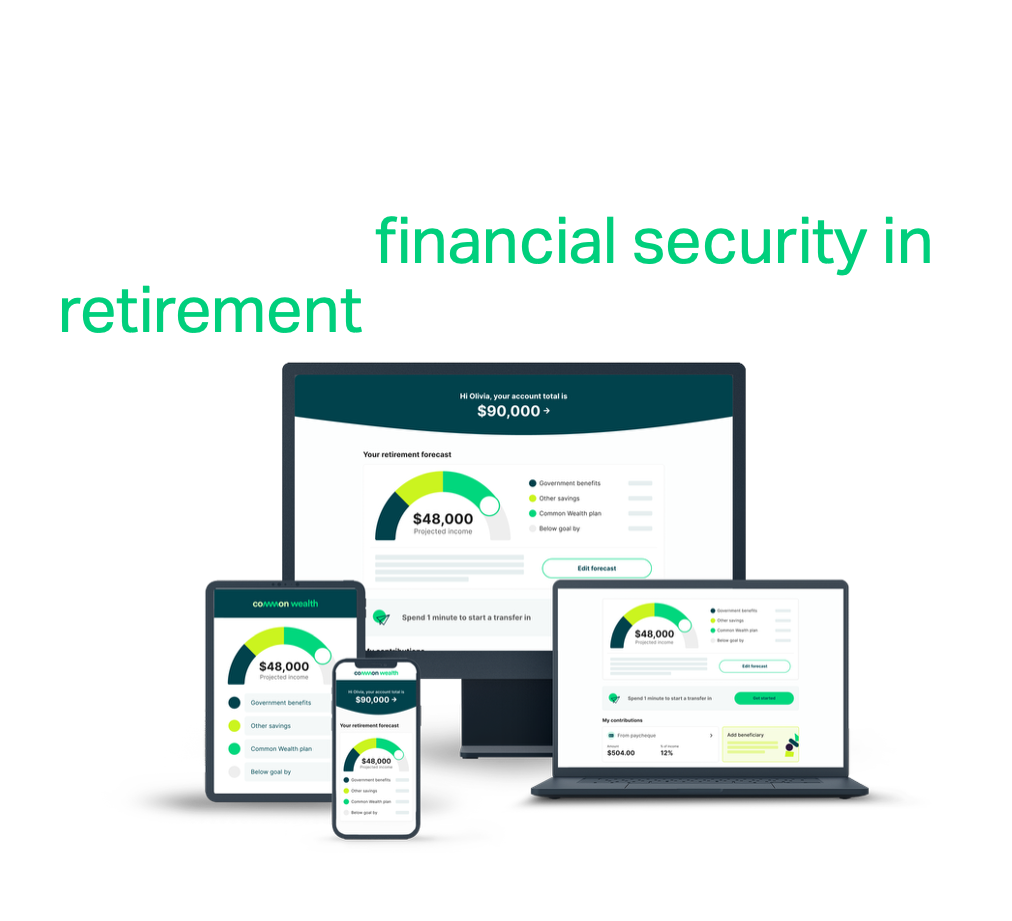
Common Wealth platform on multiple devices
Success
390+  advisors placing business
1,500+  employer clients
190+  plan transfers from legacy carriers
Full-stack technology platform built for group retirement
★★★★☆  +69Employer NPS
Awards
Pensions & Investments
Innovation Award in Technology
2022
FinTech Breakthrough
Retirement Management Innovation
2023
World Finance
Most Innovative Retirement Company
2023 & 2024
growth
Cumulative GRS Client Wins
177
EOY 2021
292
EOY 2022
516
EOY 2023
879
EOY 2024
1,372
EOY 2025
1,500
2026 YTD
1,500+
GRS client wins
to date
390+
advisors placing
business
Today's Session

What we'll cover today

1
Welcome & introductions
5 mins
2
Group Retirement 101
25 mins
3
Set-up & post-implementation journey
20 mins
Q&A and open discussion
10–15 mins
Session Goals

Learning objectives

By the end of this session, participants will be able to:

1
Identify the key components of Canada's retirement income system and explain the coverage gap that group retirement plans are designed to address
Retirement Planning
2
Describe the primary group retirement plan types available to Canadian employers — including Group RRSP, DPSP, and DCPP — and compare their tax treatment and suitability for different employer situations
Retirement Planning / Tax Planning
3
Apply knowledge of the 2024 CAPSA CAP Guidelines update to identify employer compliance needs and position a plan review conversation with existing plan holders
Regulatory Framework
4
Identify the triggers that prompt employer action and apply a repeatable sales process to move group retirement opportunities forward, including handling common objections
Practice Management
5
Evaluate plan health metrics — including participation rate, retirement readiness scores, and member engagement — and recommend appropriate interventions to improve plan outcomes
Retirement Planning / Employee Benefits
📚
Section 1

Group Retirement 101

Everything you need to know about Canada's retirement landscape, group plan types, and why this is one of the fastest-growing opportunities in financial services.

The Retirement System

Canada's three-pillar framework, CPP & OAS basics, and the retirement readiness gap that creates massive opportunity.

The Market

A $365.6B industry with 83,000+ plans. Plan types, regulatory landscape, and competitive positioning.

The Opportunity

Why group retirement is a great business for advisors — recurring revenue, compounding AUA, and underserved SMBs.

The Big Picture

The main goal of retirement finance sounds simple

Maintain your standard of living after full-time work ends.

Age Earnings Working years income Retirement income Maintain your standard of living after work
The Foundation

Canada's retirement income system

Canada's retirement security rests on three pillars — but two of them were never designed to fully replace working income. That's where advisors come in.

1
Government Benefits
CPP/QPP + OAS/GIS — Universal baseline, but limited
2
Workplace Plans
Group RRSPs, DPSPs, DC Pensions, TFSAs — Employer-sponsored
3
Personal Savings
Individual RRSPs, TFSAs, non-registered — Self-directed
Pillar 1 — The Numbers

CPP & OAS in 2026

Benefit Typical Maximum
Canada Pension Plan (CPP) ~$10K/year ~$18K/year
Old Age Security (OAS) ~$9K/year (max)
Total typical government benefits ~$19K/year

CPP Enhancement

~50% of the CPP enhancement is phased in — won't be fully phased in until 2065

CPP Contributions

Max member & employer CPP contribution: ~$4,600 each per year

OAS Spending

OAS is Canada's most expensive public program — 17% of federal spending

The Problem

Canadians are not ready for retirement

Millions of Canadians are underprepared for retirement — and the gap is widening.

Feel unprepared for retirement57%
Say savings is "prohibitively expensive"70%
Age 55-64 with $100k or less saved75%
Women age 55-64 feeling unprepared62%
Cite money as top source of stress42%

Confidence gap

59%
With workplace plan
34%
Without workplace plan

Workplace plans raise retirement confidence by 25 percentage points.

— HOOPP 2024 Canadian Retirement Survey
Sources:  57% unprepared, 70% prohibitively expensive, 75% age 55-64 with ≤$100K saved, 62% women unprepared, 59%/34% confidence gap — HOOPP 2024 Canadian Retirement Survey (Abacus Data, Spring 2024).  42% money as top stressor — FP Canada 2025 Financial Stress Index (Leger).
The Opportunity

The massive coverage gap

~450K
Small & mid-sized employers in Canada (5-499 employees)
19%
Currently have a workplace retirement plan
~365K
Small & mid-sized employers without a retirement plan

Public vs. Private Sector

Public sector RPP 87.4% Private sector RPP 20.4%

Canada vs. the U.S.

U.S. small employers ~50% Canadian SMEs 19%
Source:  C.D. Howe Institute — "Spreading the Benefits"
The Employer Perspective

Why employers set up workplace retirement plans

A workplace plan isn't just good for employees — it's a strategic business decision with measurable ROI.

1 — Recruitment
#1 tool

Rated by employers as the number one recruitment tool — a workplace retirement plan is the benefit most likely to attract top talent, especially in competitive SMB markets.

2 — Retention
20-60%

Workplace plans can reduce employee turnover by 20-60%. Given that the cost of replacing an employee runs 20%-100% of their salary, the savings add up fast.

3 — Reduced Financial Stress
~$1,000+/yr

The estimated cost of employee financial stress per employee per year. A retirement plan is one of the most effective ways to reduce it — improving focus, productivity, and engagement.

Sources:  HOOPP & Common Wealth — "The Business Case for Good Retirement Plans"Common Wealth — "Comparing the Costs of a Retirement Plan to Employee Turnover";  Financial stress cost per employee — FCAC.
Retirement Finance 101

The basics of retirement math

The replacement ratio

Financial planners typically recommend replacing 60-80% of pre-retirement income. For someone earning $75,000:

$45-60k
Annual retirement income target
~$19k
Avg. CPP + OAS provides

The gap of ~$26K-$41K/year must come from workplace plans and personal savings — that's roughly $600K-$1M in retirement savings. That's the advisor opportunity.

Why starting early matters

The power of compounding on a $500/month contribution:

$995k $502k $231k $82k Start at 25 40 years Start at 35 30 years Start at 45 20 years Start at 55 10 years
Assumes 6% annual return, compounded monthly
The Market

Group retirement is a $350B+ market — and growing

$365.6B
Total CAP assets under administration (June 2025)
83,417
CAP client plans across Canada
15.5M
Plan member lives administered

$365.6B CAP market breakdown

Group RRSP $171.8B DC Plans $164.4B DPSP $23.8B EPSP $5.6B

Top 9 CAP market grew 16.8% YoY — Benefits Canada 2025 CAP Suppliers Report

CAP = registered Capital Accumulation Plans (Group RRSP, DC, DPSP, EPSP). Excludes individual insurance-based group RRSP solutions.

Key growth drivers

  • SMB coverage gap closing through advisor-driven distribution and fintech innovation
  • Employer competition for talent driving benefits adoption
  • Regulatory evolution (CAPSA 2024 update, potential auto-enrollment)
  • Shift from DB to DC in private sector
  • Financial wellness as an HR priority
Know Your Products

Key plan types for advisors

Plan Type Tax Treatment Employer Match Vesting Best For
Group RRSP Pre-tax; taxed on withdrawal Optional Immediate Most common starter plan for SMBs
Deferred Profit-Sharing Plan (DPSP) Employer-only; taxed on withdrawal Employer only Up to 2 years Retention tool — paired with Group RRSP
Group TFSA After-tax; tax-free growth & withdrawal Optional Immediate Flexibility; lower-income; complement to RRSP
DC Pension Pre-tax; locked-in until retirement Required Varies by province Strongest governance; pension legislation applies
Regulatory Landscape

CAPSA CAP Guidelines — Updated 2024

The first major revision in 20 years signals a fundamental shift. Four themes define the new direction:

1. Outcomes, not just options

The old guidelines focused on giving members investment choices. The 2024 update shifts to retirement income adequacy — sponsors must consider whether their plan actually helps members retire well.

2. Ongoing education and planning

Sponsors should provide members with retirement income projections, financial planning tools, and access to professional advice — not just fund fact sheets. Education is now a continuous responsibility.

3. Stronger governance

Plan sponsors must regularly review investment options, fees, and member outcomes. Governance is no longer a set-it-and-forget-it obligation — it requires ongoing attention and expert support.

4. Focus on value for money

New emphasis on ensuring fees are reasonable relative to services provided. Sponsors must demonstrate that members are getting real value from their plan — raising the bar for all providers.

Why this is a massive opportunity for advisors

  • Employers need expert guidance to meet new governance standards
  • Plan sponsors must now review investment options, fees, and member outcomes regularly
  • The shift to outcomes-based thinking creates ongoing advisory relationships, not one-time sales
  • Advisors become the compliance bridge between regulators and small employers
The Value Proposition

Group plans deliver better outcomes than retail

Workplace retirement plans consistently outperform individual retail arrangements across every dimension that matters.

💰

Lower fees

Group plans leverage pooled buying power to access institutional-grade investments at a fraction of the cost of retail mutual funds — often 50%+ lower MERs.

📚

Education and planning

Group plans provide built-in financial education, retirement projections, and planning tools that members wouldn't seek out on their own.

⚙️

Payroll-based savings

Automatic payroll deductions make saving effortless. Members don't have to remember to contribute — it happens every pay cycle, building the savings habit by default.

🛡️

Stronger oversight

Fiduciary governance, regulated investment menus, and professional fund selection — members benefit from expert oversight they wouldn't get managing savings alone.

Yet 80%+ of Canadians' retirement savings sit outside of group plans — in retail RRSPs, TFSAs, and non-registered accounts — despite group plans being more efficient. That's a massive opportunity to move savings into a better structure.

The Business Case

Why group retirement is a great business for advisors

Recurring revenue

Contribution-based commissions arrive with every payroll cycle. Unlike one-time insurance sales, your income is steady, predictable, and plannable.

Compounding AUA

As assets grow through contributions + market returns, your AUA-based revenue grows too. A well-built book compounds year over year — even without adding new plans.

Deepens relationships

Group retirement gives you a seat at the table with the business owner and HR. It opens doors to benefits cross-sell, individual financial planning, and a trusted-advisor role.

Stickiness

Plans rarely move once set up. Average plan tenure is 7+ years. The switching cost is high and the relationship deepens over time — making your book highly durable.

Build Your Book

Book-of-business growth calculator

See how your group retirement book compounds over time. Adjust the inputs to model your own growth trajectory.

Assumptions
New employer plans closed annually
Average members per employer plan
Per employee (e.g., $500/mo = $6,000)
Commission on each contribution dollar
Trailing commission on total AUA
Total AUA transferred per bulk plan
One-time commission on bulk transfer AUA
25% bulk / 75% startup
6%

Cumulative AUA

Annual Revenue

Cashflow AUA-based Bulk
Section 1 — Key Takeaways

The opportunity is enormous

  • 9.1 million Canadians lack a workplace retirement plan — this is a solvable problem
  • Government benefits alone replace less than 40% of income for most workers
  • Group retirement is sticky, recurring, compounding revenue for advisors
  • Modern platforms like Common Wealth have removed the historical barriers for SMBs
  • The regulatory environment is moving toward better retirement outcomes, not just investment options
Up next: Set-Up →
The Market

Three trends in employer expectations and the GRS market

1. Member engagement is the new frontier

Increasing focus on member engagement and opportunities to add value at the individual member level. This is a chance for advisors to future-proof their model by going beyond plan setup to ongoing member outcomes.

2. The advisor's role in expanding coverage

Getting employers over the hump to set up a plan — most won't do it on their own. The industry is shifting from "my job is service" to a growth orientation: increasing block penetration, building effective go-to-market, and figuring out how to sell GRS. There's a critical role for advisors in making that happen.

3. Employers want advice, not just quotes

Employers want help navigating the market: Are you using your plan effectively in your HR strategy? Are your people getting the help they need? This advisory role is far more valuable than being a pure broker collecting quotes.

When They Buy

Employers act when something triggers urgency

Most employers don't wake up thinking about group retirement. They act when something disrupts the status quo. Learn to recognize — and create — these moments.

📈

Growth milestones

Hitting 10, 25, or 50 employees often prompts a benefits review. "We're scaling — what do our people need to stay?" is a natural door opener.

🚪

Talent loss / near-miss

A key employee leaves — or almost leaves — citing benefits. Nothing sharpens the mind of a business owner faster than an avoidable departure.

🏆

Competitor offering plans

An employer hears a competitor added a group RRSP. Or they lose a candidate to a company offering retirement benefits. Competition is a powerful motivator.

🗓️

Tax season / year-end

Business owners thinking about their own tax bill often ask their accountant about group plans. Employer matching is deductible. DPSP contributions reduce payroll tax.

📣

Employee requests

Employees asking for retirement benefits — especially in company surveys or 1:1s — put the issue directly on the owner's desk. Validate the ask and come with a solution.

⚠️

Regulatory awareness

An employer reads about CAPSA 2024 or gets flagged by their accountant. They realize their existing plan or lack thereof has a compliance gap. This is your call.

Plan Set-Up Journey

How they buy

The advisors who win aren't just finding the right clients — they're running a faster, simpler process once the conversation starts.

The old way

  • Formal RFP issued to multiple providers
  • Weeks of comparison spreadsheets and paper brochures
  • Multiple finalist presentations with large committees
  • Long decision cycles with plenty of opportunities to stall

The new way

  • Surface the need through a wellness or business conversation
  • Move quickly to a live platform demo — show, don't tell
  • Present a small number of benchmark-driven plan design options
  • Give the decision-maker everything they need to say yes
Plan Set-Up Journey

How Common Wealth accelerates this

📄

Proposals that close

Clean, visual proposals that are easy for employers to share internally and get fast sign-off.

Same-day pricing

Pricing quotes turned around the same day — and even faster with AI.

🚀

Momentum after the yes

Simple onboarding that keeps things moving once the employer is ready to go.

🖥️

On-demand demos

Common Wealth joins advisor calls to deliver live client demos on demand — no prep required on your end.

Set-Up

Opportunities to improve existing plans

📉

Low engagement

Many plan members take the employer match and disengage. A plan review can identify ways to increase participation, contribution rates, and overall member engagement.

💸

Outdated fee structures

Some plans are still on fee schedules set years ago. As assets grow, fees should be reassessed to ensure members are getting fair value for what they pay.

🔧

Plan design issues

Over time, issues build up: members in unsuitable funds, outdated investment menus, or plan designs that no longer match the workforce. A review can surface these and recommend improvements.

🏢

Service gaps

Smaller employers without dedicated HR often don't get the support they need from legacy carriers. Modern providers can offer a better experience for both employers and members.

Plans in Motion

Existing plans are an underleveraged opportunity

Most Canadian SMBs with a group plan haven't reviewed it in years. The market is moving — advisors who engage existing plan holders are finding real opportunity.

35%
of remarketed plans switched providers in the prior 12 months
NMG Consulting, 2024 Canadian Group Retirement Study
63%
of industry respondents identify Common Wealth as a disruptor in group retirement
NMG Consulting, 2024 Canadian Group Retirement Study

Signs a plan is ready for a review conversation

  • High administration fees with no fee benchmarking review in 3+ years
  • Low member participation (<50%) — sign of poor enrollment and engagement
  • No auto-enrollment, auto-escalation, or default investment options
  • Legacy carrier platform with no mobile access or member projections
  • Advisor is retiring, inactive, or simply absent from the relationship
  • Employer has grown significantly since plan was set up — plan design hasn't kept up
Set-Up

How a displacement works

From the client's perspective, a plan transfer is simpler than it sounds.

1

Sign on

Plan design and matching levels typically stay the same. No big decisions required to get started.

2

Setup

Common Wealth handles it. Employer involvement is minimal.

3

Educate employees

Employees are informed about the change and why it benefits them — through sessions and employer communications.

4

Fresh enrollment

Every employee re-enrolls. An opportunity to re-engage, revisit contributions, and nudge good behaviors like maximizing the match.

5

Assets transfer

Common Wealth receives the file and cheque from the legacy provider. Funds deposit automatically, and anyone who didn't self-enroll is auto-enrolled.

Set-Up

The real cost of a group retirement plan

Most employers overestimate the cost and underestimate the flexibility of a group retirement plan.

Plan Inputs
%
Based on industry benchmarking, ~70% of eligible employees typically enroll in a new group plan.
Cost per participating employee / month
$271
Match as % of payroll
3.5%
Total annual employer cost
$113,750
Total employees 50
Participating employees 35
Avg salary $65,000
Employer match 5% of salary
Total annual cost $113,750
Each participating employee receives $3,250/yr
Match rate scenarios
Match Annual Cost Monthly Per Emp/mo
The demo as a tool

Show, don't tell — a short demo educates more than an hour of presentation

👁️

Show, don't tell

Seeing the platform in action answers more questions in 2 minutes than a brochure does in 20. Employers understand what they're setting up — and so do their employees.

Builds momentum fast

A live demo creates real interest and urgency. It answers "how does it work?", "why is it better?", and "how do we get started?" — all in one conversation.

🧑‍💼

Shows the employee experience

Employers care about whether their team will actually use the plan. The member-side experience — mobile app, projections, enrollment flow — is your strongest argument for participation.

Section 2 — Key Takeaways

The best advisors know the market

  • Know your buyer — decision makers and priorities shift with company size
  • Trigger events create urgency — growth milestones, talent loss, and benefits reviews open doors
  • The old RFP process is giving way to faster, demo-driven sales — Common Wealth supports you at every step
  • Existing plans are an underleveraged opportunity — most haven't been reviewed in years
  • Objections are normal — the answers are straightforward when you know what's really behind them
Up next: Post-Implementation Success →
🚀
Section 3

Post-Implementation Success

The plan is live. Now the real work begins — keeping it healthy, building member trust, and growing your book.

The New Governance Model

From compliance checkboxes to genuine member outcomes — what good plan oversight looks like in 2026.

Metrics That Matter

What employers and advisors should be tracking — participation, engagement, retirement readiness, and AUA growth.

Ongoing Education

Building trust and understanding with members through embedded tools, webinars, employer channels, and expert access.

Growing the Plan

The key add-ons that deepen plan value — match increases, financial planning access, and onboarding integration.

Plan Governance

The new standard for plan oversight

The old way

  • Compliance as finish line: tick the box, file report
  • Emphasis on reviewing investment lineup
  • Long reports client doesn't want to read
  • Limited visibility into members' retirement health, if benefit it working

The new way

  • Focus on outcomes: is the plan actually working?
  • Focus on usage & adoption: are employees engaging with and using the plan?
  • Real-time plan health data: participation, retirement health, digital engagement
  • Advisor as ongoing partner, not annual visitor
Metrics That Matter

What employers should be tracking

A good plan review doesn't need a 100-page fund report. It needs a clear answer to one question: is this plan actually working for our people?

Participation

What % of eligible employees are enrolled? Below 70% is a signal that action may be needed (e.g., education campaigns)

Engagement

Engagement is what makes a plan visible to employees. Invisible benefits don't drive retention.

Retirement Readiness

Common Wealth calculates a Retirement Readiness Score for every member. Employers can see aggregate scores — a powerful proxy for whether the plan is working.

Returns and funds

Investment returns matter — but in context. Are members in age-appropriate funds? Are fees reasonable?

Post-Implementation

What a plan review looks like

Client-ready simple CAP report available for download directly from Common Wealth Advisor.

Page 1
Plan Review Page 1
📄
[Page 1 sample cap report.png]
1
2
1
Participation tracked against industry benchmarks
2
Retirement readiness scored by age group
Page 2
Plan Review Page 2
📄
[Page 2 sample cap report.png]
1
1
Investment returns reported with full methodology
Page 3
Plan Review Page 3
📄
[Page 3 sample cap report.png]
Get in touch

Connect with your Common Wealth team

Matt Iannuzzi
Matt Iannuzzi
[email protected]
to navigate  |  1 2 3 for sections